
FOSSILS, HOOKER AND CHERRY COUNTIES
The first recorded remains of fossil ele-phants in Nebraska were found in 1857 near what is now Mullen, Nebraska. (a newspaper clipping with no identification or date on it but stated the fact was from UNL Newslet-ter.)
January 25, 1918 the local newspaper stated: “ . . . each succeeding day seems to bring new glory to someone, and now we are told that millions in riches that has laid hidden in south Hooker County all these years has been opened up within the grasp of Tom Quinn in rich deposits of potash in a lake situated on his land. Recent analysis of its waters show a 10 percent solid . . . With the discovery of so much wealth so near at hand comes much speculative talk as to the best means of taking care of it. Plans are being made for a large refining plant and many believe Mullen is the proper place to locate it. Mr. Quinn sees the advantage of being connected up with a main line of railroad rather than depending on the extension of the Stapleton branch to build into south Hooker County, and if proper financial inducement is forthcoming, here is very likely where the plant will be located and a pipe line laid to the lakes for conveying the raw material to this point.'' (With the war ending this did not materialize)
March 29, 1929 "Hooker County Tribune" had an article as follows “While trailing along the forks of the North Loup river a few days ago, Mach Carrier's curiosity became aroused when he sighted an unusually large bone extending from a gyp bed. After discovering the object to be of stone, he set about digging and when he quit the job, he had several fine specimens of what is believed to be the frame of a mastadon or some other prehistoric monster. On account of much frost being in the ground, Mr. Carrier had considerable difficulty in resurrecting the ten specimens he brought to this office last Saturday to be placed on display, but there are yet many specimens in the gyp bank that could be removed at a later time. A pair of tusks are among the display, thus indicating they likely are part of the defense apparatus of a mastadon that roamed this section thousands of years ago. George Griffith informs us that he made a similar find in a sand bank in E.P. Ericksen pasture ten miles northwest of Mullen last summer.''
In July of 1939, a part of scientists from the University of Nebraska Museum headed by C. Bertrand Schults, Assistant Director, were in Mullen and vicinity and spent sometime at the sand and gravel pit on the McCully and Bramer ranch just north of town on the Middle Loup River, where they found a number of fossilized bones, among them being parts of the skeleton of an ancient camel. From Mullen the party went to Erik, located about 7 miles northwest of Mullen, in answer to a letter telling them of a fossil deposit. They found quite a large bed of fossils on the ranch belonging to Mr. Mona-han. Before leaving town Mr. Schults stated that if permission could be secured from Mr. Monaham permitting them to excavate these fossils, that a field party would be sent to the ranch and would probably spend several weeks there in removing those fossils. Mr. Schults mentioned that a great wealth of fossilized material of scientific value was to be found in this vicinity. (in part from a "Hooker County Tribune")
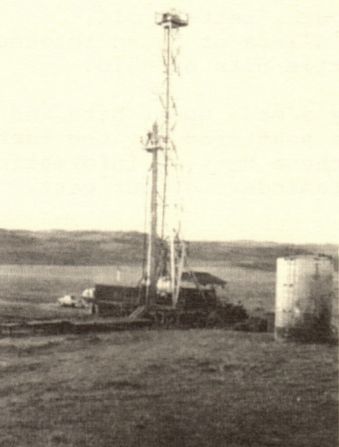
In the spring of 1952, an oil company drilled for oil on the R/M Ranch, that of W.R. Machlan 10 miles southeast of Mullen. This lasted for several weeks until they struck granite. The hole was plugged and the rig removed. There have been other wells tried but seem to have the same result. It was said this was the first oil well rig brought into Hooker County, which did bring out many spectators.