
FRANKE CONSTRUCTION COMPANY
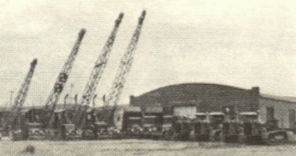
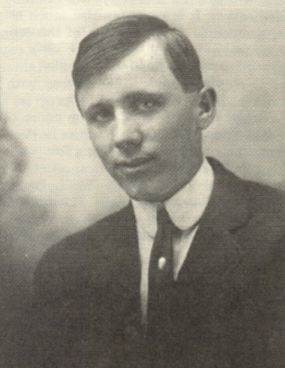
R.C. Franke “Ole'' established his business in Mullen, Nebraska in 1922. He operated his business alone for a short time then Novem-ber 1, 1923, his first Austin dragline arrived on a flat car in Mullen, the `real' beginning of Franke Construction Company. Quote from Ben French, “I went in the shop for something and Mr. Franke, asked if I would like a job with a ditching crew for 45 cents an hour.'' “Ole'', Bert Barnett, Marion Bul-lington and Ben French went to work piling ties for a ramp to unload the dragline. This was quite a machine at that time, weighing 25 tons with a 45 foot boom, one yard bucket and traveled one mile per hour in fast gear. It took 3 days to get to the John Vinton ranch and then the crew had to learn how to operate the dragline. The ground froze too hard to work that fall but after it thawed in the spring, a ditch was dug up to the Vinton buildings, and then up to the Reimer Ranch. When the job was finished the dragline was driven back to town, loaded on a flat car and shipped to Merriam, Nebraska where the Coffee Ditch of about 10 miles was dug, resulting in the drainage of several lakes. Highway 20 west of Merriman was graded in the summer of 1924 and “Ole'' got the contract to load dump wagons pulled by mules for the surfacing. The fall of 1925 and `26, “Ole'' wanted to run 2 shifts on the ditch at the Dumbbell Ranch north of Hyannis, Nebraska and hired Stanley Meidell to oil. Ben French operated the night shift. When the ground froze the crew shut down for the winter.
To begin with, most of the work was done with a dragline digging ditches and loading trucks, for road surfacing. Finishing was done with horses and scrapers. Later as blades, patrols, and scrapers became available, horses were pretty well retired in the middle thirties.
Mr. Franke's dream was to see the day when the water in the Sandhills was used to the fullest extent. It pleased him anytime a dry valley was the receptacle for the drainage of an over-wet hay meadow.
In the 26 years following the beginning of the company he built a business that em-ployed up to 60 men during the construction season, building roads, bridges, railroad grades, dams, drainage ditches and related earth moving jobs. For several years his organization loaded virtually all of the sugar beets in the North Platte Valley, west of North Platte in 1932. When he began loading beets for the Great Western Sugar Company, a project which lasted 2 or 3 months every fall, the equipment in use then for the operation was inadequate for the job, so Mr. Franke invented, built and patented an overshot loader attachment for a crawler tractor which was used for beet loading. One man operating the Franke loader easily could load 35 to 40 gondola cars in 8 or 9 hours. Draglines with clam shells were also used in this operation. Although Mr. Franke nevere sold any of his productions they did facilitate his job. He went to Washington State with his patent, and Isaacson's Iron Works redesigned his production making a smaller one to handle coal. “Ole'' was able to operate and repair any piece of equipment that was used in his varied projects and upon occasion did so until his health failed in December 1949. The construction of his shop building was completed in 1931 and the office building in 1946. Frank Fitzgerald built the office build-ing.
The company maintained a high safety record considering the high danger of jobs encountered. An accident did occur at Craw-ford, Nebraska in 1933 when a leaking dragline fuel tank that was being repaired exploded. This explosion resulted in the disfiguration of Mr. Franke's face and Fritz Pearson suffered facial burns and an arm injury. Stanley Meidell and Art Piester were less seriously injured.
Shortly before Mr. Franke's death in March 1950, he incorporated his business including three employees, Charles Folk, Paul Isom, and Wayne Fitzgerald.