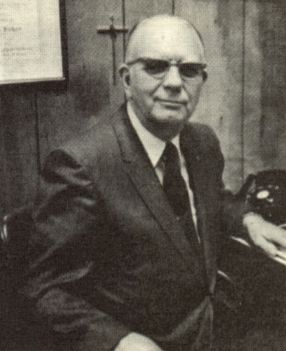
BAKER, HAROLD S. PhD.
At the Annual Conference in September 1941, we were appointed to our second parish, Mullen, Nebraska, the county seat of Hooker County. We arrived in Mullen late and the town was dark. There were two street lights on main street. We were apprehensive, as litterly, there was no room in the Hotel as it was filled with cattle buyers. Our first contact was Dr. David Walker, pioneer Sandhill physician. He had just returned from a house call, located somewhere out in the hills. He welcomed us in his warm way, then from his office called Mr. and Mrs. Charles Boyer, who welcomed us to stay overnight in their home.
The next morning as I looked out the window on that September day, I could see the dull light of an impending storm over the rolling hills covered with dry grass yellowed by an early freeze, this, as far as the eye could see.
We spent WWII years in Mullen. We wept with those who lost loved ones and rejoiced and welcomed those who returned. One must live in the Sandhills to know the true warmth and love of those hardy people.
A baby, granddaughter of Dr. and Mrs. Walker, was brought 58 miles for baptism, my first Sunday in the Mullen Methodist Church.
During my pastorate at Mullen, I was appointed County Assistance Director and Child Welfare Worker for Hooker and Grant Counties, an area of several hundred square miles. I had the opportunity to live with nature, driving those sandhill roads (trails), in an experience one never forgets. Trails winding along through the valleys between the high grassy hills. One could see herds of white faced cattle grazing and little calves dotting the hills where left by their mothers. Once in awhile a coyote would slip through the tall grass. One could hear the trumpeting of the prairie chickens and the grouse, and watch the mating dance of the cocks. Here and there a rattlesnake would come under the sights of my rifle, which I carried with me for just that purpose. There were times when a pheasant would grace our supper table.
Dr. Walker was on the go both day and night. We had no hospital in the area and it was a trek of a hundred miles to Alliance to the west or one hundred miles east to Broken Bow and some eighty miles to the south to North Platte. We had a 1939 two door Ford that I had changed so the seat could be removed and a bed made for patients to be transported to a hospital. Gasoline and tire rationing was no problem as we were given priority along with the Dr.
One evening at a basketball game, a young man asked if we could take his mother to Alliance Hospital. She had cancer of the throat and was bleeding profusely. It was a foggy night and the road was winding with two lanes. We started out with a prayer and guts. The daughters in the back seat with the patient, tearing sheets to absorb the blood. We traveled the one hundred miles in exactly one hundred minutes, with the patient in her room. Our drive home was a little less trying. The sun came up over the eastern hills with a beauty I have never known before or since.
Names and faces are very clear from over forty years ago. Lifetime friends were made and many are gone, but their families still remain. The Roy McCully's, Bill and Sara Bramer in the bank, the Johnson family owners and operators of the large Mercantile store. The Simonsons, the Ericksens, the Hardings, Wayne and Helen Fitzgerald, Dr. Earl (dentist) and Helen Walker, Glen and Claudia Tompkins, the Buechler family, Mac Osborne's, the Barnebeys and many others, whose faces and voices are very real to us right now.
We were able to instigate two important programs while in Mullen. Our first was a Sunday School by mail program. Wayne Fitzgerald and I worked out the program. Children were sent lessons to be completed and returned every week. This program received publicity and notoriety through Religion in the News program on radio from Washington D.C. The other program is still in use, The God's Herd Calf Sale. This was initiated here and the yearly event helped build a new and beautiful sanctuary.
Several of the friends we made, about our age, (Mary and I), and who had families like ours, met about once a week for fun and fellowship. We tried to have a picnic and cookout once a month, and during the winter we would go to the Loup River and shovel away the snow for our fire. Pheasant hunting was also a pleasure, and Mary enjoyed it right along with the best shots in the area. Rattlesnake hunting was an adventure, too. Wayne Fitzgerald and a few other fellows and I would go out to a prairie dog town in the late fall and find the rattlers out on top of the dog mounds and we would shoot their heads off with our twenty-two rifles. The rattles were our trophies and at the end of the day the hunter with the most rattles took the pot, perhaps a dollar. Wayne took most of the pots.
September 1946, brought tears and hear-tache, when we were assigned to a new parish, Bassett and Newport. However, we all left part of ourselves in this little Sandhill community, and it will always be home to the Baker family.
(The above has been taken from the story of my life prepared for my fifty year celebra-tion in the ministry)