
BOYER, HUGH BEE AND SARAH ANN (HUNTSMAN)
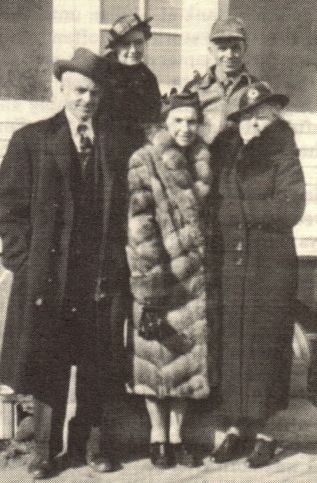
Hugh Bee Boyer and his wife Sarah came to Mullen by train from Elkhart, Texas in 1900, with their 3 children, Haskle 6, Lessie 4, and Gussie 8 months. Born in Mercer County, West Virginia 4 June 1871, he traveled by team and wagon with his parents, Dennis & Sarah E. Fielder Boyer, to Tennes-see in 1872, then on to Anderson County, Texas in 1878, where he grew to manhood on a farm near Elkhart. Hugh and Sarah were married near Crockett, Texas on Easter Sunday, 12 April 1891. She was the oldest child of Charles and Amanda Jane (Hassell) Huntsman of Crockett.
Sarah wrote in 1956 about their experi-ences as follows: “ . . . we sold what we had, which was not much and took the train to arrive in Mullen March 21, 1900 at 3 A.M. It was cold and sprinkling a little snow. There was a box car depot, a small hotel, one general store which handled lumber, coal, posts, wire, hardware, dry goods and groceries. The post office was in the same building. The owner, H.J. Lowe and wife Mary, two sons, Lewis & Elliott, lived in a soddy back of the store. There was also a saloon and pool hall with a barber. There was one tree in the town and two livery barns. We went to the country with Uncle Steve James to Dennis Boyer's home-stead. We then found a place two miles from Hugh's parents and filed on the homestead of 160 acres. With the help of Uncle Steve and Uncle Hugh Boyer and their boys we soon had a sod house and a good well. We bought 2 milk cows, 4 horses and some chickens. Also a mowing machine and rake. We planted garden in the sod which had been plower for a fire guard. We raised two wagon loads of pumpkins, watermelons and squash and shared with anyone who needed them. Also a nice field of corn on 12 acres of sod & put up a nice bunch of hay. All was so new to us, with no weeds or sandburrs to bother, and no cultivation necessary as required in the south where we had raised cotton. We planted a few boxelder roots and they grew real well. In a few years we had a little shade. Later we planted some other trees and by that time other folks had planted trees. Now there is a nice grove of trees in most every valley. The first prairie-fire we witnessed started 20 miles north in October 1900. It burned clear to the Loup River east of Mullen. There was not much loss other than range land, as the settlers knew they must have good fire guards plowed around their homes.
“There was no school, doctor, or minster among the few settlers, and none in town 7 1/2 miles away. There were no roads only as you made one by driving the same way each time. I remarked to some of the other settlers that I did not want to stay if we could not have a Sunday-school, so immediately one was organized. We met at Uncle Steve James' and people attended from 10 to 15 miles around. We then built a two story house 16' X 20' with a hall between the frame and soddy. It was finished in time to put up our Christmas tree and a few families came in and spent Christmas eve with us. The trimming on the tree was paper chains made of colored wrapping paper and strings of popcorn. We were all happy and enjoyed what we had immensely.
“The next need was a school, so the neighbors got together and built a school house. The first year we just had a 3-month school in the spring about one mile from our home. We had Sunday school in the school house and soon got the preacher that came to Mullen, to come out and preach for us once a month. Grandpa Deaton was one of the early preachers. We would gather at the school house for box suppers to help pay the preacher.
“On the 4th of July we had picnics, foot races, nail driving contests, some bucking horses and a big dinner all together. In 1908 we tore the frame house down and built a 7-room frame house with two porches. In 1917, Hugh's asthma got so bad he could no longer work with the livestock. Haskle had just finished Ag school at Lincoln, but could not help as he was called to the Army. We built a new brick house on the hill in southeast Mullen and moved in 1917, November. Our daughter, Lessie and husband, John Goldiz-en, moved back from Wyoming and took over the ranch. In the spring of 1919 the ranch house caught fire during the night and burned down. Lessie and John fixed up a small house to do until a better house could be built, but after the crop was in, they moved back to Wyoming.''
In completing her story, Mrs. Boyer said, “Now in 1956 I have seven grand-children, all in homes of their own and good christian families. I feel the seeds were sown out there at those little gatherings and l enjoy thinking, “God led me then as now. ''
Hugh and Sarah were active workers in the Methodist Church. Hugh painted houses in Mullen and painted many of the one-room school houses which were common. He was also county assessor for many years. Sarah was known for the many quilts she made and helping others in times of sickness or trouble. They kept many roomers and boarders through the years and were frequently sent guests from out of town when the hotel was full.
Hugh died 17 March 1954 at the age of 82, and Sarah 5 March 1968 at the age of 94. Both are buried in Cedarview Cemetery at Mullen.
Their children, Haskle, married Elvia May Fox 15 June 1920, had 6 children. Lessie married John Goldizen 8 May 1915 and had one daughter. Gussie married Mac Osborne 18 May 1924, they had one son. Gussie lives in Mullen.