
CRAWFORD, ALBERT AND HILMA (ANDERSON)
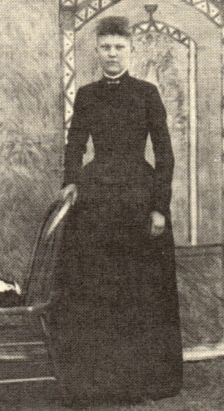
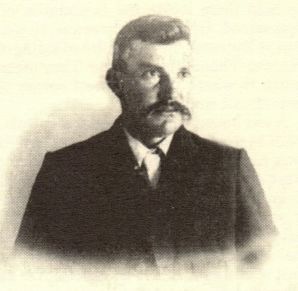
Albert Crawford was born June 17, 1868 at Winterset, Iowa to parents James and Mary Crawford. His boyhood in Iowa was not the most pleasant due to the destitution caused by the Civil War of only a few years before, and the money panic of 1873, a bare existence was about all that could be hoped for.
In 1883 the family moved to Boone County, Nebraska, near the Cedar River. Life was much better here: There was plenty of food to eat and meat always was available. By trapping and earning some money, Albert was able to have his first gun – a muzzle-loading shotgun, he was in his glory for he loved to hunt.
He came with his father in the fall of 1887 to look for free land in the Seneca-Mullen area that some friends, the LeLaCheurs, who had lived neighbors to them in Boone County, were recommending. At this time Albert was not old enough to take a home-stead. His father, Jim, found land 2 miles north of Kelso siding in Thomas County Territory, which later became Hooker County, March 29, 1889, and filed on it as a tree claim. He also filed on 160 acre home-stead 4 miles east of there, along the Thomas County line. About 2 years later, Albert filed on land adjoining in Hooker County. After the Kinkaid Act of 1904, he filed on land adjoining it in Thomas County. Though the land was free, the price was still high: living with the gnats, and later fleas, was nearly unbearable. On hot, still days the gnats were so thick, they could hardly breathe without inhaling them and they fed freely on people's ears and back of their neck. Soon the fleas came and were everywhere where there was grass and they were always hungry. They later left the grass and were found in buildings and corrals.
Albert liked to hunt and made good use of the muzzle-loading shotgun here in the hills. He soon made enough money by hunting prairie chickens to market and buy a new shotgun and get a bird dog. The market hunting season lasted about 6 weeks each year and he would average about 30 to 35 birds a day. The entrails had to be drawn and cavity filled with green grass right after being shot. No water was used, it would cause them to spoil. Each day they would need to be taken to Seneca, where they were frozen and packed in barrels and shipped to eastern markets, at 20 to 25 cents a bird and sometimes 35 cents, it was REAL money at that time.
Albert and Jim started at Mercantile Store in Seneca in 1893, with one or the other going from the farm each day. They operated the store until about 1908.
Al, as he was being called, married Hilma Anderson November, 1899 at the Anderson family home east of Seneca. Hilma became a school teacher soon after she and her folks came to the Sandhills from Illinois, in April 1888. She taught school in Dill Valley; Merz school near Swan Lake; Norway and in Seneca before their marriage. Their children were: Anna (Babe), Bud, Ore who died when he was 2 years old, and Alvo. The family lived in town though Al did commute to the country to do the farming and care for the livestock.
Beside the store, Al started a meat market close by, only to have it burn in 1910 in a fire that started in the livery barn and burned four businesses in all. After the fire he bought the Pool Hall that he operated for 2 years until he found some very nice corn growing on a place near his farm that could be bought for $10 an acre. He had always been a farmer at heart, so he sold the Pool Hall and bought the farm, never to return to business in town again.
During his years in business he was a “locator'' as they were called, one who is a surveyor and could show settlers their exact land. He traveled with a team and wagon for miles around. His price was $5 a day unless they camped out under the stars overnight, when it was $10. He also surveyed several roads in Thomas and Cherry Counties. The last surveying he did was up near Pony Lake in Cherry County in 1942. He was elected Thomas County Surveyor for years.
During WWII a group formed a flying club, bought a training plane and established an airport at Al's place. Since there was no airport between North Platte and Valentine at that time there was quite a little activity.
It is unique that the first automobile Al ever saw, drove into his yard in 1909; the first radio he listened to, was in his own home; the first airplane he saw in the air, was from home; his first airplane ride was from his own place. Al lived to see his land farmed for 64 years. He was the first to grow alfalfa in Thomas County. He and Hilma lived on the homestead the rest of their lives. Hilma passed away in 1944, Al in 1952. Hilma liked to raise a garden and did much canning of it, fruit, meat, etc. She liked to raise chickens and turkeys. She particularly enjoyed Project Club with neighboring friends. Al and Hilma endured many privations, as did all the pioneers carving out a niche in our great Sandhills, leaving it to us much better than they found it.