
FITZGERALD, FRANK E. AND EDITH (OLIVER)
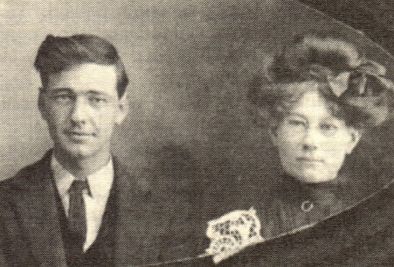
Frank E. Fitzgerald and wife Edith (Oliver) Fitzgerald arrived in Mullen, Nebraska with their two sons, Wayne R. and Corliss V., ages three and two years, respectively in the month of March, 1913. Burlington train No. 43, then simply called “43'' pulled into the brick depot platform about 10:00 A.M. this chilly March morning. Wayne, his nose flattened against the coach window, was singing out, “We're coming to Mulling, We're coming to Mulling.'' The family was met by the proprietor of the Evergreen House, pushing a two-wheeled cart to carry hand luggage to the hotel or Evergreen House, the name then. James Oliver, the proprietor, was also father of Edith Fitzgerald and grand-father of Wayne and Corliss.
Frank Fitzgerald lived and worked in the building construction and maintenance busi-ness in the Mullen area from his arrival in 1913 at the age of thirty one years until his death at seventy six in June 1958. He was born in Litchfield, Illinois February 3, 1882, the youngest of six children. He came to Mullen about three years after becoming a master carpenter by serving as a carpenter's helper and an apprentice during the con-struction of Fort Russell, a federal military installation in Cheyenne, Wyoming. This was in the early years of 1900.
Frank and Edith May Oliver were married in 1904. As a young woman before her marriage Edith had helped her parents in the operation of hotels and eating houses in Callaway, Nebraska. So, when Frank and Edith came to Mullen she again assisted, working at the Evergreen House as cashier and waitress. She also was an exemplary mother, wife and homemaker. She was expert in the preparation of wild game and fish.
Mullen and Hooker County were part of the area covered by the Kinkaid Act and enjoyed the boom condition created by the many farmers, ranchers and tradesmen that were coming in to the town and vicinity. It was into this agreeable atmosphere for work and business that Frank Fitzgerald came.
In 1913 Mullen had a half dozen or so buildings that were not wooden frame struc-tures. The court house, Rosebery's store, a few cement block buildings, stores and homes and one or two brick residences. Fitzgerald, commenting on the early structures, said when he came here the only building he knew of with rabetted door jambs and weight balanced windows was the then new court house. No building had indoor plumbing and very few, if any of the homes had a full basement, so common today. Nor was there an open stairway with an ornate curving banister of the type quite common in the farming area of eastern Nebraska. One of Frank's first jobs in Mullen was construction of the grain elevator. I did a brisk business for a few early years before the folly of plowing sandhill land became apparent. In the spring of 1917 Fitzgerald and George Hawley joined forces bought two lots on Main Street (First Street) next to the just-complet-ed Ham Hotel and built the building pres-ently occupied (1986) by the Hampton Agency and Long's Recreation. Hawley own-ed the east half and Fitzgerald the west half of the building. The Fitzgerald family made their home in the second floor west apart-ment for the next five years. 1917 to 1922.
From the founding of Mullen with the coming of the railroad until 1910, a little over 20 years, of the houses constructed there were perhaps twenty five good structures. Many of them with maintenance and renovations were occupied in 1986. A number of them are on Second Street beginning on the west with the Roseberry house, now the Assembly of God parsonage to the home of A.G. Humphrey, now owned by the Bob Boyer family.
From 1913 until the late thirtys Fitzgerald did a lion's share of the building. He built more than forty five homes, schools, ranch houses and other buildings in Mullen, Sene-ca, Hyannis and Whitman and the country around. In 1935 to 1937 he built five homes and two business buildings in North Platte. In the early years house construction was not the assembly of preconstructed, prefinished units. Door frames, window frames, stair parts etc. were shop work or built on the site. Window sash and house doors, millwork items, were generally available at the local lumber yards.
After World War II there were many changes in home construction. Then there were mobile homes, double-wides and factory assembly methods. After this most of Frank's work was repair and maintenance and cabin-et work. In the early 1950s he gradually retired, working less and fishing more.
Edith died in 1969 at age eighty six.